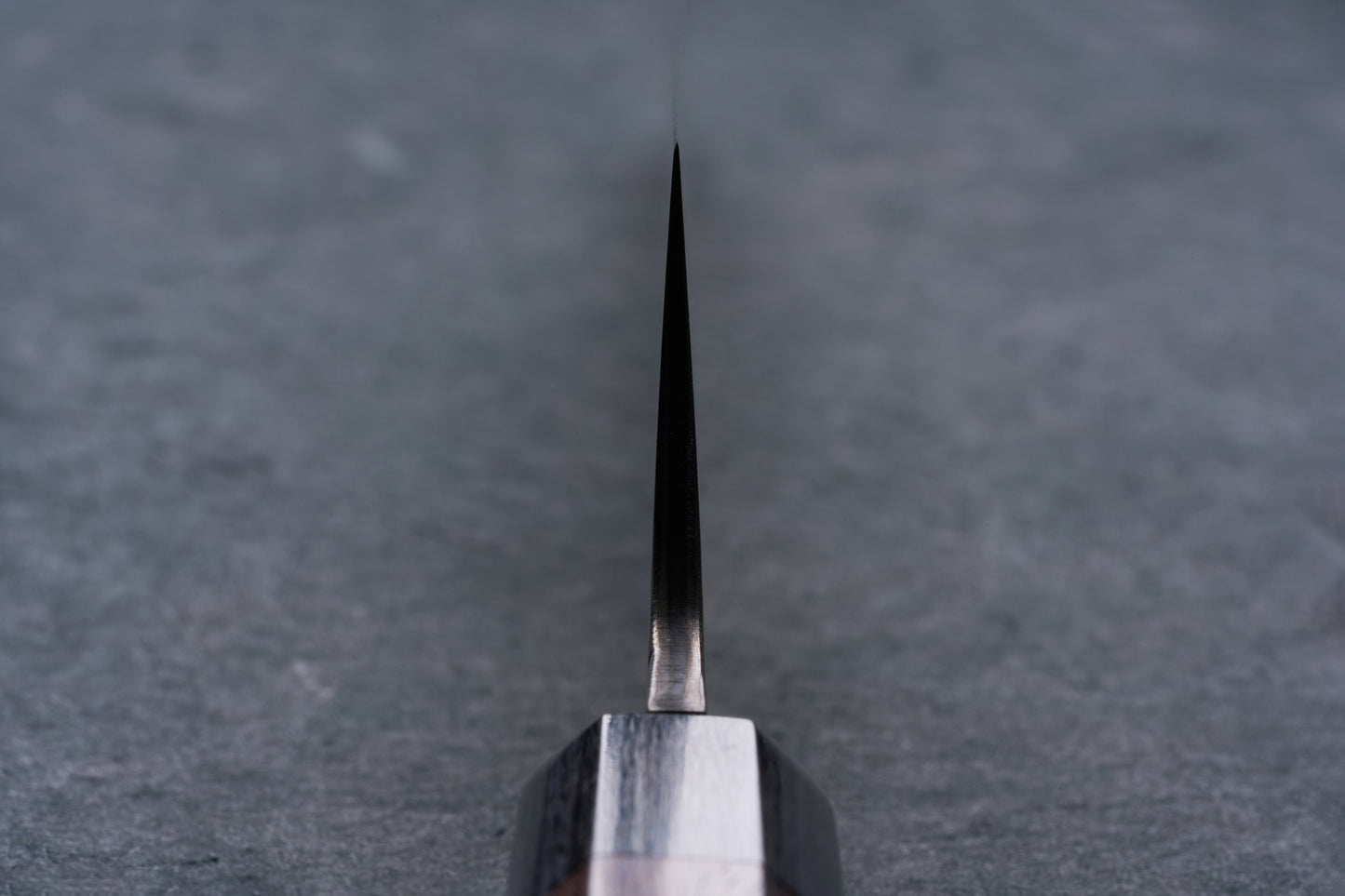
Kisuke Manaka KOKUENN Sujihiki 280 mm
Kisuke Manaka KOKUENN Sujihiki 280 mm
3 $ de frais de livraison pour toute commande de plus de 100 $ au Canada.
| MOINS DE 100 $ | PLUS DE 100 $ |
|---|---|
| 15 $ | 3 $ |
Ce couteau sera disponible lors de notre vente d'entrepôt du printemps de Knifewear, le samedi 9 mai à 8 h (heure des Rocheuses).
Vous ne savez pas ce qu'est la vente d'entrepôt ? Cliquez ici pour en savoir plus.
VOIR LA GAMME COMPLÈTE ICI
Les prix actuels reflètent les prix de vente finaux
Impossible de charger la disponibilité du service de retrait
À propos de Manaka Hamono - Kisuke Manaka est un forgeron de 5e génération, relativement jeune, originaire de Kasukabe, dans la préfecture de Saitama. En 2025, il a déménagé à Sanjo Tsubame, un haut lieu de la forge au Japon. Il a commencé à fabriquer des couteaux à partir de zéro il y a environ 10 ans, avec seulement un atelier rempli d'équipement et sans mentor. Il est entièrement autodidacte, mais il a maîtrisé les techniques de soudage à la forge d'aciers, même le soudage à la forge d'acier inoxydable, ce qui n'est pas une tâche facile.
Ce magnifique motif Damas est créé et forgé à la main avec de l'Aogami #2 et de l'acier au carbone doux par Manaka-san, en le manipulant plusieurs fois. Il soude ensuite à la forge de l'Aogami #1 au milieu pour l'acier du cœur.
À propos de la forme - Sujihiki se traduit littéralement par "Trancheur de chair" et fait exactement ce que son nom suggère. Il est parfait pour découper et trancher les rôtis, la dinde, les viandes crues, le poisson et toutes les autres protéines. La longueur étendue de la lame permet de trancher d'un long mouvement au lieu de faire glisser le couteau d'avant en arrière comme une scie, et la surface réduite empêche la lame de coller à la viande. Les tranches nettes de poitrine de bœuf ou les applications ultra fines comme le Carpaccio deviendront un jeu d'enfant à exécuter.
| Shape | Sujihiki |
|---|---|
| Maintenance Level | |
| Blade Length | | |
| Blade Height | |
| Thickness | 2,9 mm |
| Weight | |
| Steel Type | |
| Dureté Rockwell | 62 - 64 |
| Edge/Bevel | |
| Handle | Manche wa (japonais) - |
| Blacksmith | Kisuke Manaka |
| Made in | Tsubame-Sanjo, Niigata, Japan |
Une note sur les mesures : Les couteaux japonais faits à la main peuvent varier dans leurs dimensions, ces mesures ne sont donc qu'un exemple.
Knife Care
Knife Care
Additional Details
Additional Details
SKU: MNKKOKUENN280SU
Expédition et retours
Expédition et retours
Chez Knifewear, nous nous engageons à expédier votre commande dans un délai d'un jour ouvrable. En cas de retard, nous nous efforcerons de vous en informer et de vous donner un délai.
Nous offrons la livraison à 3 $ pour toute commande de plus de 100 $* partout au Canada et de 200 $* pour les clients aux États-Unis. Nous livrons partout dans le monde et proposons des tarifs actualisés de notre partenaire d'expédition DHL.
*Les grils Konro et certains autres articles plus volumineux sont exclus de l'offre de livraison gratuite.
Comment puis-je retourner une commande en ligne?
Pas de soucis, nous avons ce qu'il vous faut. Rendez-vous sur https://knifewear.com/returns et suivez les instructions.
Puis-je récupérer ma commande en bordure de trottoir / en magasin?
Absolument, tant que tous les articles que vous recherchez sont en stock à l'emplacement où vous souhaitez les récupérer, vous pourrez sélectionner cette option à la caisse. Si un ou plusieurs articles ne sont pas disponibles à l'emplacement de votre choix, nous serons heureux de vous les expédier.
Request Additional Info
Request Additional Info