Passer aux informations produits
1 de 3

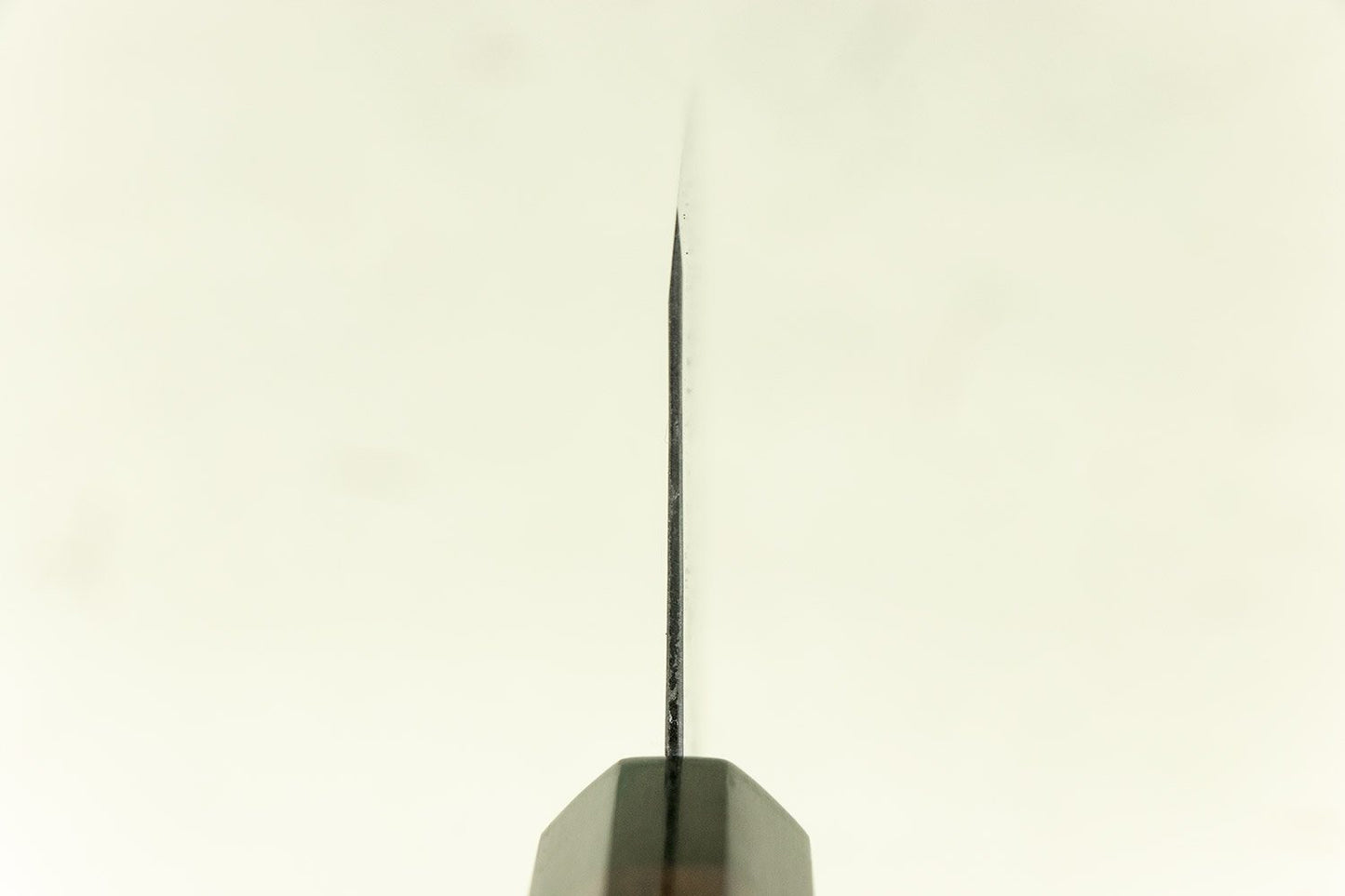
Takeda NAS Funayuki Santoku 180mm

Takeda NAS Funayuki Santoku 180mm

Prix habituel $485.00 CAD
Prix habituel Prix promotionnel $485.00 CAD
En vente Épuisé

3 $ de frais de livraison pour toute commande de plus de 100 $ au Canada. ?

À propos de la forme : C'est également un couteau polyvalent, mais avec une légère tendance pour les légumes. Santoku signifie « trois vertus » ou « résoudre trois problèmes ». Les vertus ou problèmes sont le tranchage, la découpe en dés et le hachage. Le Santoku est généralement disponible en longueurs de 160 mm à 190 mm. Ces couteaux sont de plus en plus populaires dans les cuisines occidentales en raison de leur forme unique et de leur taille plus petite et facile à manipuler.

À propos du forgeron : Les couteaux de Shosui Takeda déchirent, tout simplement. Maître forgeron de troisième génération, Takeda-san est né et a grandi à Niimi, Okayama, au Japon. Après avoir obtenu son diplôme universitaire à Tokyo, il est retourné dans sa ville natale pour succéder à son père en tant que maître forgeron pour Takeda Hamono. Depuis 1985, il s'efforce de produire les meilleures lames et outils forgés à la main. Chaque lame est une œuvre d'art unique et a une certaine présence. Forgeant des couteaux, des haches, des hachettes, des faucilles et des faux, il semble que rien ne soit impossible pour Takeda-san.

Shape Santoku
Maintenance Level
Blade Length 180 mm |
Steel Type Aogami Super (Blue Carbon Steel) avec habillage en acier inoxydable
Dureté Rockwell 63 - 64
Edge/Bevel Double (50/50)
Handle Manche de style japonais - Octogone Bois de rose Collier en bois de pakka noir
Blacksmith Shosui Takeda
Made in Niimi, Okayama, Japan

Une note sur les mesures : Les couteaux japonais faits à la main peuvent varier dans leurs dimensions, ces mesures ne sont donc qu'un exemple.


Carbon steel gets crazy sharp and holds an edge very well, but can rust. Stainless steel has the benefit of being less prone to rust but isn’t quite as sharp. Luckily, Japan has the solution. They make lots of kitchen knives by sandwiching 3 layers of steel together. In the case of kitchen knives the softer, outside layer is stainless and the hard core is carbon steel. The best of both worlds, super sharp — with low hassle. These are some of the most popular knives we sell. The exposed core steel can rust, and you have to wipe it dry to keep that from happening, but this is only a small part of the knife. Over time, the edge will oxidize from from shiny to a dull grey, this oxide layer slows down rust.

USE  

• Only cut food you can bite through with this knife. Hard foods can chip the blade. No olive pits, bones,  lobster shells, woody stems or parmesan rinds. Cutting frozen food is especially bad  because the cold will make hard steel even more brittle. If you wouldn’t chew it with  your own teeth, don’t cut it.  

• Your cutting surface is the biggest culprit of dulling your knife. Use wood. End  grain wood is especially good. Plastic can be fine too, but certainly not glass,  granite or bamboo

• The edge of your knife works best sliding forwards or backwards. Scraping the  knife edge sideways will dull or damage the edge. Instead, use the spine of the knife to move foods across the cutting board. Do not twist the edge or pry with the edge, this is the worst screwdriver you ever bought and these motions will certainly  damage the edge. Listen to the knife! If you can hear the edge making a “tink”  sound on the cutting board, change what you are doing.  

CLEANING  

• After use, wash the knife by hand with regular dish soap, rinse with hot water  and dry by hand immediately. Dishwashers are very bad for knives.  

• Wood handles may dry out over time and exposure to water. Simply treat them  with some food safe mineral oil or beeswax.  

• If you see orange rust, remove it. The scrubby side of a sponge can do the trick.  If it’s still not coming off try baking soda and water mixed into a paste or a product  called Barkeeper’s Friend.  

STORING  

• Protect the edge; for your safety and to avoid edge damage. A simple blade cover  will do the trick if you keep knives in a drawer or travel case. 

• A convenient wall magnet made with wood is a great way to show off your knives.  Be sure to put it back spine first, then roll it onto the blade face. This will keep the  edge from contacting the wood first.  

• The good-ol’ counter top block can keep knives at the ready and protected. So can  drawer inserts. Whatever the method, keep the edge from touching anything else. 


SKU: TAAS180SA-SM

Expédition et retours

Chez Knifewear, nous nous engageons à expédier votre commande dans un délai d'un jour ouvrable. En cas de retard, nous nous efforcerons de vous en informer et de vous donner un délai.

Nous offrons la livraison à 3 $ pour toute commande de plus de 100 $* partout au Canada et de 200 $* pour les clients aux États-Unis. Nous livrons partout dans le monde et proposons des tarifs actualisés de notre partenaire d'expédition DHL.

*Les grils Konro et certains autres articles plus volumineux sont exclus de l'offre de livraison gratuite.

Comment puis-je retourner une commande en ligne?
Pas de soucis, nous avons ce qu'il vous faut. Rendez-vous sur https://knifewear.com/returns et suivez les instructions.

Puis-je récupérer ma commande en bordure de trottoir / en magasin?
Absolument, tant que tous les articles que vous recherchez sont en stock à l'emplacement où vous souhaitez les récupérer, vous pourrez sélectionner cette option à la caisse. Si un ou plusieurs articles ne sont pas disponibles à l'emplacement de votre choix, nous serons heureux de vous les expédier.

Request Additional Info

Afficher tous les détails
Great customer service
large Selection
Satisfaction Guaranteed

Overall rating: 5.0 / 5 from 21 reviews.

AI Generated Review Summary

Summary topics

Review topics: ["staff","blade","knife"].

Review highlights

Reviews

Exceeds Expectations

"I traded a Takeda Bunka for my Funayuki. It's a great little knife. I'm eager to take a shot at sharpening it, but it feels just as sharp as it did a ton of meat and veggies ago. . . I'm going to check it's edge on a Bess Tester and if it's below 200, I'm going to use that as an excuse to sharpen it!! LOL!!"

David S. (5/5)

My favorite go to knife!!!

"super lightweight and comfortable to use. Cuts through any vegetables and fruits I throw at it with ease. My favorite go to knife!"

Jayant S. (5/5)

Best of the Best

"Amazing knife maker To quality and beautiful design that does its job perfectly"

Peter G. (5/5)

Very happy with my purchase!

"Love this knife. It is our second. One for the house, one for the cottage."

Rod L. (5/5)

Takeda traveler

"A useful work of art that traveled 16000 kliometers to me in Poland. It cuts great, light in hand, looks beautiful, and this heart kanji ❤️"

Paweł L. (5/5)

Another great Takeda blade

"Love this knife, perfect for daily tasks and is thin with a good bit of flex. What more can you say, it’s a Takeda."

Jay L. (5/5)

Amazing knife

"Light , agile , and obviously insanely sharp - make sure you have a ceramic hone and or leather strop - a steel won’t do much but possibly chip the blade."

Mike D. (5/5)

Insanely sharp right out of

"Insanely sharp right out of the box! Definitely worth the money, and I’ll be buying another Takeda soon!"

Morris B. (5/5)

It's The One With The Heart On The Blade

"Everything they say about these knives is true. If you are a knife person you really need to experience cutting with one of these knives."

Michael R. (5/5)

Love the feel, weight and

"Love the feel, weight and ease it cuts"

Roy S. (5/5)

Q&A

What are the average measurements on the heel of the knife?
Hey there, it tends to vary between 57-60mm deep at the heel, let me know if you have any other questions! - Ellie

Consultés récemment