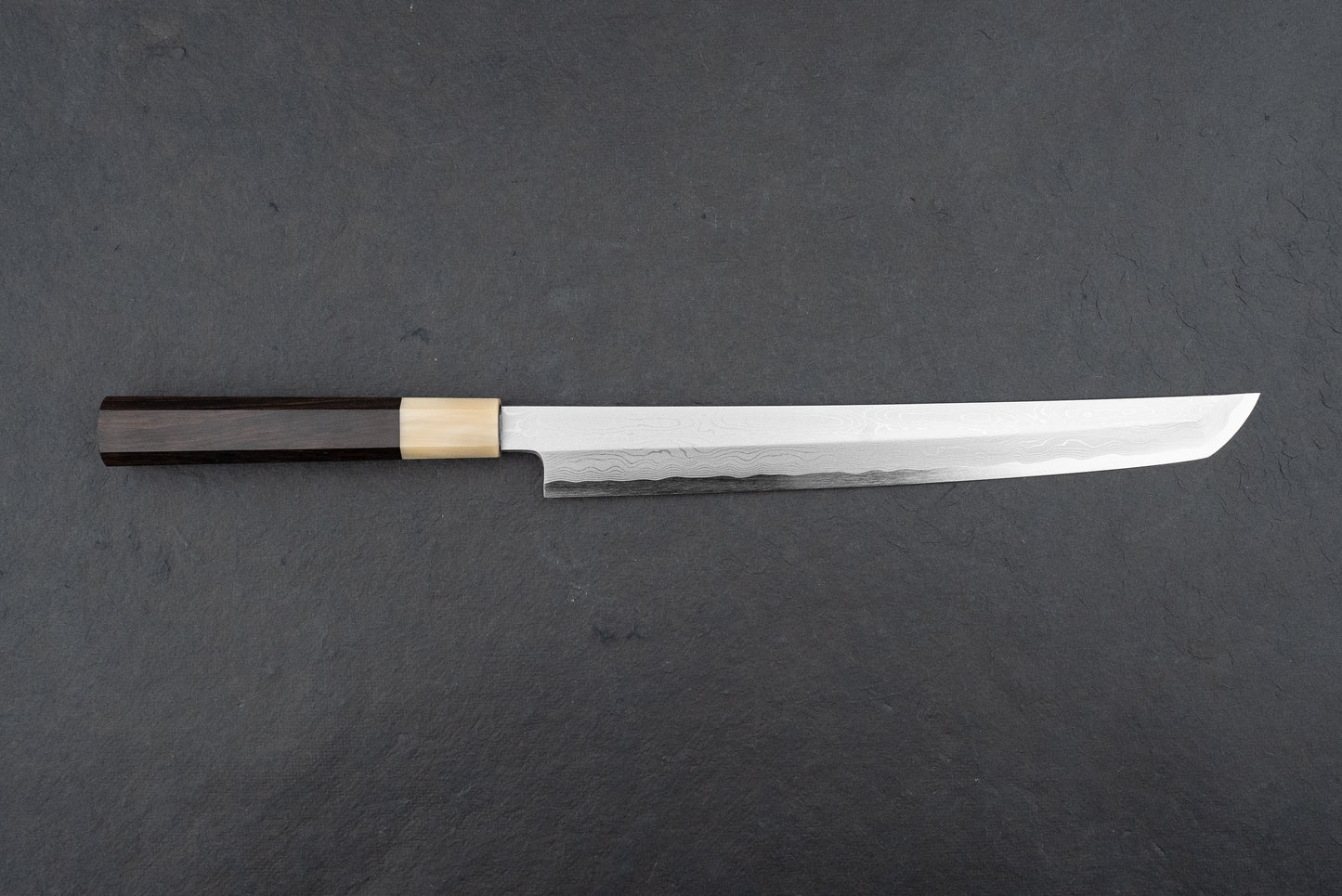
Sakai Kikumori Aoichi Sakimaru Takobiki 300mm
Sakai Kikumori Aoichi Sakimaru Takobiki 300mm
3 $ de frais de livraison pour toute commande de plus de 100 $ au Canada.
| MOINS DE 100 $ | PLUS DE 100 $ |
|---|---|
| 15 $ | 3 $ |
Ce couteau sera disponible lors de notre vente d'entrepôt du printemps de Knifewear, le samedi 9 mai à 8 h (heure des Rocheuses).
Vous ne savez pas ce qu'est la vente d'entrepôt ? Cliquez ici pour en savoir plus.
VOIR LA GAMME COMPLÈTE ICI
Les prix actuels reflètent les prix de vente finaux
Impossible de charger la disponibilité du service de retrait
À propos de la forme - Le Sakimaru Takobiki est un type de forme au sein de la famille Yanagiba. Le Yanagiba est le rêve d'un trancheur. Gracieux, sexy et capable d'une netteté incroyable, vous trouverez un Yanigiba entre les mains de chaque chef de sushi digne de ce nom. Yanagi signifie "feuille de saule" et fait référence à la forme longue et étroite de ce couteau.
Le Yanagiba est une lame japonaise traditionnelle qui n'est affûtée que d'un seul côté, appelée « biseau unique », et lui permet de couper plus précisément que les autres lames. Traditionnellement utilisés pour trancher les sashimis, ils accompagnent aussi bien le rôti de bœuf, le jambon ou le foie de veau. Une fois à Yanagiba, vous n'y retournerez plus.
À propos de Sakai Kikumori - Sakai Kikumori est un grossiste à Sakai, un peu comme Sakai Takayuki et Konosuke. Ils travaillent avec plusieurs forgerons et affûteurs dont Shiraki Hamono, Yoshikazu Tanaka et Morihiro.
L'acier aogami utilisé dans ce couteau est très traditionnel, capable d'un tranchant fou. Il a tendance à rouiller un peu moins facilement et reste affûté un peu plus longtemps que son cousin le shirogami.
| Forme de couteau | Sakimaru Takobiki |
|---|---|
| Longueur de lame | 300mm |
| Type d'acier | # 1 Aogami (acier au carbone bleu) |
| Dureté Rockwell | 62 : 64
|
| Forme de la poignée | Octogone |
| Matériau de la poignée | Manche en bois de magnolia avec collier en corne |
| Couteau Ligne | Sakai Kikumori |
| Shape |
Sakimaru Takobiki
Also know as?
You could also call it a
Yanagiba,
depending on what part of Japan you are in.
|
|---|---|
| Maintenance Level | |
| Blade Length | | |
| Blade Height | |
| Thickness | 4 mm |
| Weight | |
| Steel Type | |
| Dureté Rockwell | 62 - 64 |
| Edge/Bevel | |
| Handle | Manche (japonais) Wa - Octogone Ébène Collier en corne de buffle d'eau |
| Blacksmith | Satoshi Nakagawa |
| Made in | Sakai, Osaka, Japan |
Une note sur les mesures : Les couteaux japonais faits à la main peuvent varier dans leurs dimensions, ces mesures ne sont donc qu'un exemple.
Knife Care
Knife Care
Additional Details
Additional Details
SKU: YWHAODM270SK
Expédition et retours
Expédition et retours
Chez Knifewear, nous nous engageons à expédier votre commande dans un délai d'un jour ouvrable. En cas de retard, nous nous efforcerons de vous en informer et de vous donner un délai.
Nous offrons la livraison à 3 $ pour toute commande de plus de 100 $* partout au Canada et de 200 $* pour les clients aux États-Unis. Nous livrons partout dans le monde et proposons des tarifs actualisés de notre partenaire d'expédition DHL.
*Les grils Konro et certains autres articles plus volumineux sont exclus de l'offre de livraison gratuite.
Comment puis-je retourner une commande en ligne?
Pas de soucis, nous avons ce qu'il vous faut. Rendez-vous sur https://knifewear.com/returns et suivez les instructions.
Puis-je récupérer ma commande en bordure de trottoir / en magasin?
Absolument, tant que tous les articles que vous recherchez sont en stock à l'emplacement où vous souhaitez les récupérer, vous pourrez sélectionner cette option à la caisse. Si un ou plusieurs articles ne sont pas disponibles à l'emplacement de votre choix, nous serons heureux de vous les expédier.
Request Additional Info
Request Additional Info