


First Japanese knife purchase
"I’m not disappointed in this buy at all. Super sharp out of the box, feels really good in my hand, and it looks beautiful on my magnetic block!"
Vous possédez un compte ?
Connectez-vous pour payer plus vite.

3 $ de frais de livraison pour toute commande de plus de 100 $ au Canada.
| UNDER $100 | OVER $100 |
|---|---|
| $15 | $3 |
Impossible de charger la disponibilité du service de retrait
Garage Sale Disclaimer/Rules
➤ No holds, no special deals, no discounts, items are priced to move!
➤ First come, first served.
➤ No pre-sales, we gotta keep it fair!
➤ Retail location inventory is exclusive to each store on the first day. So come in early!
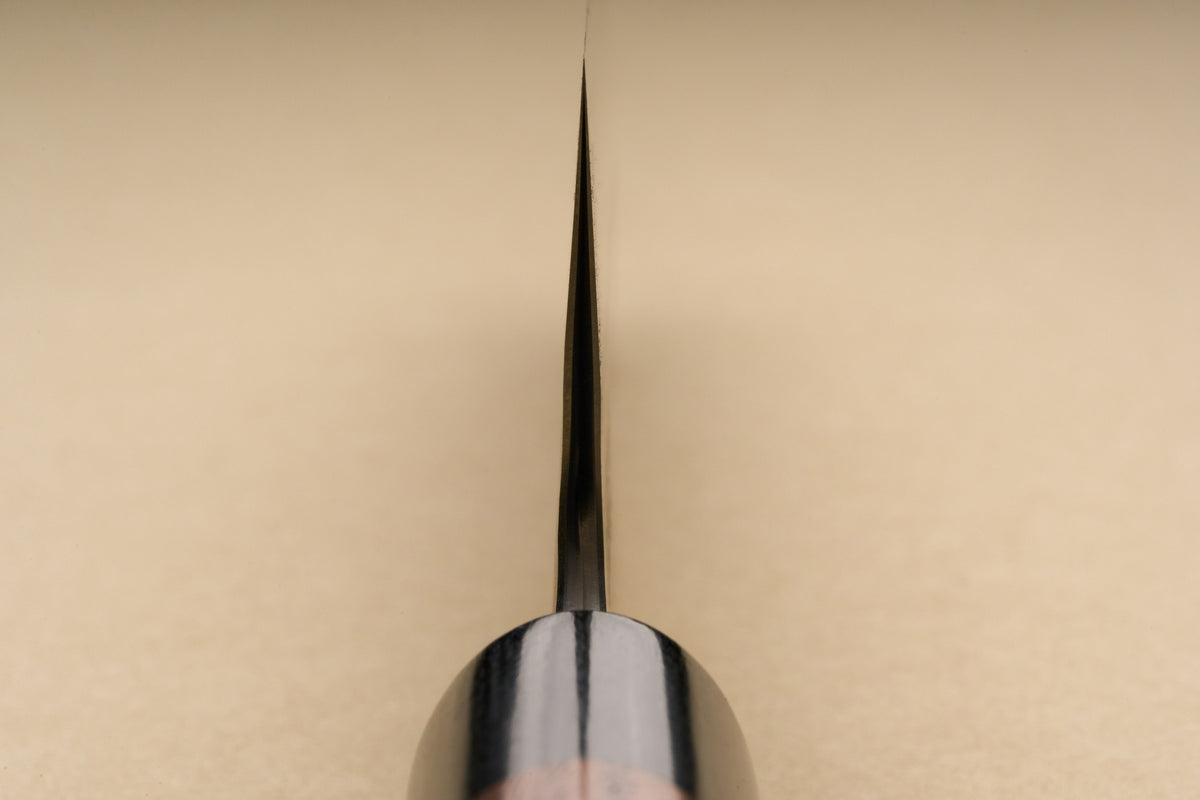
À propos de la forme: C'est également un couteau polyvalent, mais avec un léger biais végétal. Santoku signifie «Trois vertus» ou «Pour résoudre trois problèmes». Les vertus ou problèmes sont le tranchage, le coupage et le hachage. Le Santoku se trouve généralement dans des longueurs de 160 mm à 190 mm. Ceux-ci deviennent de plus en plus populaires dans les cuisines occidentales en raison de leur forme unique et de leur petite taille facile à manipuler.
À propos de Katsushige Anryu: «Le fer est vivant», dit-il. "Il peut vivre et il peut mourir, selon le forgeron." La carrière de plus de 6 décennies d’Anryu san lui a donné une incroyable compréhension de l’acier et fait de lui l’un des forgerons les plus prolifiques de sa région. Il est à juste titre fier d'être l'un des fondateurs de Takefu Knife Village.
Anryu san s'en tient à la tradition quand cela fonctionne à son avantage, mais n'a pas peur d'introduire de nouvelles techniques et aciers s'ils peuvent améliorer ses couteaux. Bien qu'il soit né en 1940, Anryu san continue de travailler dur, d'innover et de transmettre ses compétences à de jeunes forgerons.
| Forme du Couteau | Santoku |
|---|---|
| Longueur de la Lame | 165mm |
| Type d'Acier | #2 Aogami (Carbone bleu) avec couverture en acier inoxydable |
| Dureté Rockwell | 61:63 |
| Poignée | Poignée Wa (Japonaise),Ovale en bois de rose avec collet en bois de pakka noir. |
| Forgeron/Fabriquant | Katsushige Anryu |
| Shape | Santoku |
|---|---|
| Blade Length | | |
| Blade Height | |
| Thickness |
4,1 mm /
1 mm
ⓘAbove the Heel / 1cm from the tip.
|
| Weight | |
| Steel Type | |
| Dureté Rockwell | 62 - 63 |
| Edge/Bevel | |
| Handle | Manche wa (japonais) - Ovale Bois de rose Collier en pakkawood noir - |
| Blacksmith | Takumi Ikeda |
| Made in | Echizen, Fukui, Japan |
Une note sur les mesures : Les couteaux japonais faits à la main peuvent varier dans leurs dimensions, ces mesures ne sont donc qu'un exemple.
We aim to ship your order within 1 business day at Knifewear, if there is a hold up, we'll aim to let you know and give you a timeline.
We offer $3 shipping on orders over $100* anywhere in Canada and $200* to customers in the USA. We ship worldwide, and offer up to the minute rates from our shipping partner DHL.
*Konro Grills and some other larger items are excluded from the free shipping offer.
How do I make a return on an online order?
No worries, we've got you sorted. Head over to https://knifewear.com/returns and follow the prompts.
Can I pick up my order Curbside / At the store?
Absolutely, as long as all the items you are looking for are in stock at the location you want to pickup from, you'll be able to select that at the checkout. If one or more items aren't at your preferred location we are happy to ship it to you.


Overall rating: 4.8333335 / 5 from 6 reviews.
Review topics: ["knife"].
"I’m not disappointed in this buy at all. Super sharp out of the box, feels really good in my hand, and it looks beautiful on my magnetic block!"
"Fantastic santoku,"
"love this knife. beautiful, perfect balance, and razor sharp right out of the box."
"Everything perfect. Best knifes in town. Nice staff."
"Light and precise. Love this knife."
"This is our first Japanese knife and we love it! It makes cutting anything so easy."