Chan Chi Kee (CCK): Sweet Chinese Cleavers from Hong Kong

Chan Chi Kee (CCK) : couperets chinois sucrés de Hong Kong

En Chine, ainsi que dans les foyers et restaurants chinois du monde entier, les couteaux de cuisine sont généralement grands et rectangulaires. Les « hachoirs » chinois vont des trancheurs ultra-fins aux hachoirs à os épais et sont étonnamment polyvalents. Certains des meilleurs couteaux de chef chinois sont fabriqués par Chan Chi Kee (陳枝記) basé à Hong Kong, et nous sommes ravis de les proposer chez Knifewear !

Histoire et réputation des couteaux Chan Chi Kee

Chan Chi Kee (abrégé en CCK) est en activité depuis plus de 100 ans. L'entreprise porte le nom de son fondateur, aujourd'hui décédé, mais elle continue d'être détenue et exploitée par la famille Chan. Ils sont récemment passés d'un estampage en relief à l'ancienne pour le logo sur la lame à un processus de gravure laser plus futuriste, mais CCK fabrique toujours ses couteaux de manière traditionnelle.

Ces couteaux de chef chinois classiques ont toujours eu une excellente réputation en Grande Chine et sont de plus en plus connus en Occident également. Le chef Anthony Bourdain a acheté un couteau CCK lors d'un épisode de son émission « The Layover ». Un hachoir CCK a été présenté dans « Milk Street » de Christopher Kimball, avec des démonstrations sur son utilisation. Et Fuschia Dunlop, experte en cuisine chinoise et auteure de livres de cuisine, est connue pour recommander le vénérable CCK.

Lorsque je vivais à Hong Kong, les gens me disaient que CCK se distinguait des autres fabricants de couteaux chinois en raison de leurs méthodes de forgeage de l'acier. J'ai un hachoir en acier au carbone de poids moyen de leur part depuis des années et j'ai constaté que cette affirmation était vraie : il est extrêmement facile à aiguiser et garde bien son tranchant. Mais il tache aussi énormément, j'ai donc développé une belle patine ! Les nouveaux modèles en acier au carbone ont une laque protectrice qui aide à atténuer les taches et la rouille.


Mon couteau civil et militaire CCK bien-aimé.

À propos des hachoirs chinois CCK et des spécifications techniques

Comparé à d'autres couteaux, un CCK restera généralement aiguisé plus longtemps qu'une lame allemande ou chinoise moyenne, mais pas aussi longtemps que la plupart des couteaux japonais. Ils ne spécifient pas le type d'acier ni la dureté, mais j'estime qu'ils se situent entre 57 et 59 HRC. La durabilité des couteaux Chan Chi Kee dépend beaucoup de leur épaisseur, et ils fabriquent des hachoirs pour tous les usages. Cela dit, ils sont tous suffisamment durs pour rester aiguisés pendant de longues périodes sans être trop cassants ou sujets aux dommages.

Les manches en bois en forme de tonneau des hachoirs CCK ont un aspect très traditionnel. La partie du couteau qui s'insère dans le manche est la « soie », et elle traverse tout le manche avant d'être repliée à l'extrémité. Cette méthode de construction traditionnelle a un bel aspect rustique mais est extrêmement pratique. Les manches sont solidement fixés mais peuvent toujours être remplacés !

Les numéros sur la lame des couteaux CCK suivent un système de classement chinois de taille par rapport aux autres de la même gamme. Plus le nombre est grand, plus le couperet est petit par rapport aux autres de la même série. Un #4 est le plus petit et un #1 est généralement le plus grand, mais la plus grande taille est parfois marquée XL. Ce système de numérotation est inclus dans les numéros de modèle, bien que toutes les séries n'aient pas tous les numéros. Par exemple, la série 130X comprend les 1303, 1302 et 1301 du plus petit au plus grand.

Voici quelques-uns des hachoirs chinois CCK que nous avons disponibles chez Knifewear :
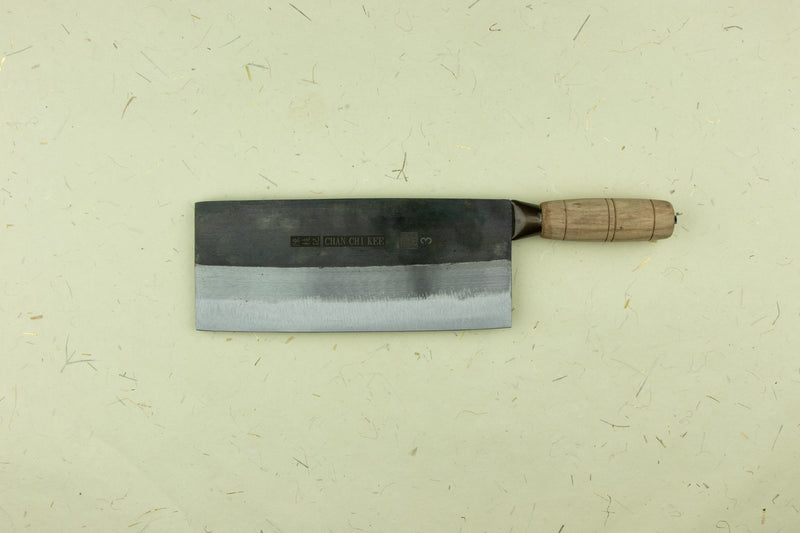
CCK Cleaver "Mulberry Knife" Small Slicer 210mm - KF1303 from Chan Chi Kee (CCK)

CCK Cleaver "Mulberry Knife" Petite Trancheuse 210mm - KF1303
Prix habituel $165.00 CAD
Prix habituel Prix promotionnel $165.00 CAD
En vente Épuisé

In Cantonese, this extremely thin blade is referred to as a “song dou” (桑刀) by CCK, meaning ‘mulberry knife.’ Depending on who you ask, the name is because it’s as thin as a mulberry leaf, or because it can cut food into slices as thin as a mulberry leaf, or because it can be used to cut mulberry leaves into superfine threads as food for silkworms. 

You can use this featherweight Chinese chef’s knife to cut all kinds of food, but only use it on things you can chew with your teeth. Chopping hard stuff like bones or frozen food would chip it. The mulberry knife is made from reactive carbon steel, which can rust if left wet and/or dirty. That being said, it has a food-safe lacquer on it that will gradually wear away with use and be replaced with a protective patina, which helps make it easier to maintain.

Prix habituel -
Prix habituel Prix promotionnel $19.99 CAD
En vente Épuisé

This lightweight cleaver is ever so slightly thicker than the 1303, and CCK calls it a “siu peen dou” (小片刀), meaning ‘small slicing knife.’ A slicing cleaver is a versatile Chinese chef’s knife good for meat, fish, fruit, veggies, cheese, etc. Just stay away from hard bones, shells, pits, and stems! The 1912 is made from stainless steel, so it won’t rust unless badly abused. This knife is a perfect introduction to the world of Chinese cleavers because it is affordable, easy to take care of, and relatively durable while still providing excellent cutting performance.

Prix habituel -
Prix habituel Prix promotionnel $19.99 CAD
En vente Épuisé

This knife has a unique shape that is designed for butchery but is actually quite versatile. In Cantonese, CCK calls it a “hoi touh dou” (開肚刀), meaning ‘stomach opening knife,’ because it is meant for gutting tasks. It has a nice taper along the spine that allows the back of the edge to be used for deboning poultry (joints, not bones) as well as slicing meat towards the upswept tip. The height of the blade makes it great for chopping veggies along the flat spot at the back, while the heavy curve at the front is amazing for rock chopping herbs, similar to a mezzaluna or an ulu. A majority of the carbon steel blade has a protective lacquer finish, which will wear away over time and be replaced with a patina. Just make sure to wash and dry it immediately after use or the edge could rust!

CCK Cleaver "Vegetable Knife" Stainless Steel Chopper 195mm - KF1904 from Chan Chi Kee (CCK)

CCK Cleaver Acier Inoxydable Petite Trancheuse 205mm - KF1912
Prix habituel $187.00 CAD
Prix habituel Prix promotionnel $187.00 CAD
En vente Épuisé

Knifewear’s most recent addition to our Chinese cleaver lineup is what CCK calls a “choi dou” (菜刀) in Cantonese, translating literally to ‘vegetable knife’ but meaning ‘food knife.’ This welterweight cleaver is what a lot of heritage users would be most familiar with as the sole blade in their parents’ or grandparents’ kitchen. Looking for one knife to rule them all? Look no further! It’s capable of slicing meat, chopping vegetables, and even cutting small poultry or fish bones. The stainless steel blade won’t rust easily, and it’s a bit smaller than some dual-purpose cleavers, which makes it manageable for all sizes of people.  

Prix habituel -
Prix habituel Prix promotionnel $19.99 CAD
En vente Épuisé

There is a special spot in my heart for what CCK labels a “manh mouh dou” (文武刀) in Cantonese, literally meaning ‘civil and military knife.’  Almost a decade ago, my very first Chinese cleaver was a civil and military, and I still use it regularly! The name is a reference to a philosophical binary of yin and yang in Chinese thought that expresses opposites in the socio-political sphere. In the knife world, it earns that name by being able to handle both fine and rough jobs. This is a big knife. As a middleweight cleaver, it can do just about everything; it goes from fine mincing garlic to chopping up turkey carcasses with great aplomb. As a jack-of-all-trades but master-of-none, it’s easily the most versatile knife I own. CCK now puts a layer of lacquer on the blade to protect it from rust, but you’ll still need to keep it dry or risk rusting the edge. As the lacquer is worn down, the blade will stain and take on a lovely patina.

CCK Cleaver Kau Kong Chopper 205mm - KF1411 from Chan Chi Kee (CCK)

CCK Cleaver Kau Kong Chopper 205mm - KF1411
Prix habituel $189.00 CAD
Prix habituel Prix promotionnel $189.00 CAD
En vente Épuisé

The Kau Kong chopper is a beast of a cleaver, and its name literally means ‘Nine Rivers knife,’ which CCK calls a “Gau Gong dou” (九江刀) in Cantonese. That name is thought to be a reference to a city in China whose borders are similar to the shape of the knife. The blade is front-weighted and heavy, but it actually tapers nicely from spine to edge and heel to tip. The back half of the blade is thick enough for chopping fish, poultry, and small pork bones, while the front half is still thin enough to chop meat and veggies. As a light-heavyweight cleaver, it’s super versatile. Nonetheless, the Kau Kong chopper is not ideal for delicate work because of its sheer weight. It’s made of full carbon steel with a lacquer finish. While not difficult to take care of, make sure to keep it dry to prevent rust.

As a Chinese cleaver enthusiast, I highly recommend adding one—or more!—of these knives to your collection. I have three CCK knives and am looking at getting a fourth. Happy chopping, folks!

Retour au blog
   Colin McQuire

Colin McQuire

Back in the day Colin cooked at a couple restaurants in Edmonton, and he used to make knives too. He later moved to Toronto and was seduced by a career in music, though he continued sharpening knives for friends and family. By night, he DJ'd and produced beats as Ronin E-Ville, and by day he taught music at several universities, all while training to become a kung fu master. Colin eventually moved to Ireland, working as a music researcher for a couple years and learning to make shillelaghs. Since returning to Canada, Colin is stoked to be getting back to his roots with knives, happily nerding-out on steels, blacksmiths, and sharpening. If you want to know about Chinese-style cleavers (chuka bocho), Colin’s your guy!